
The Handwritten Note That Changed My Energy
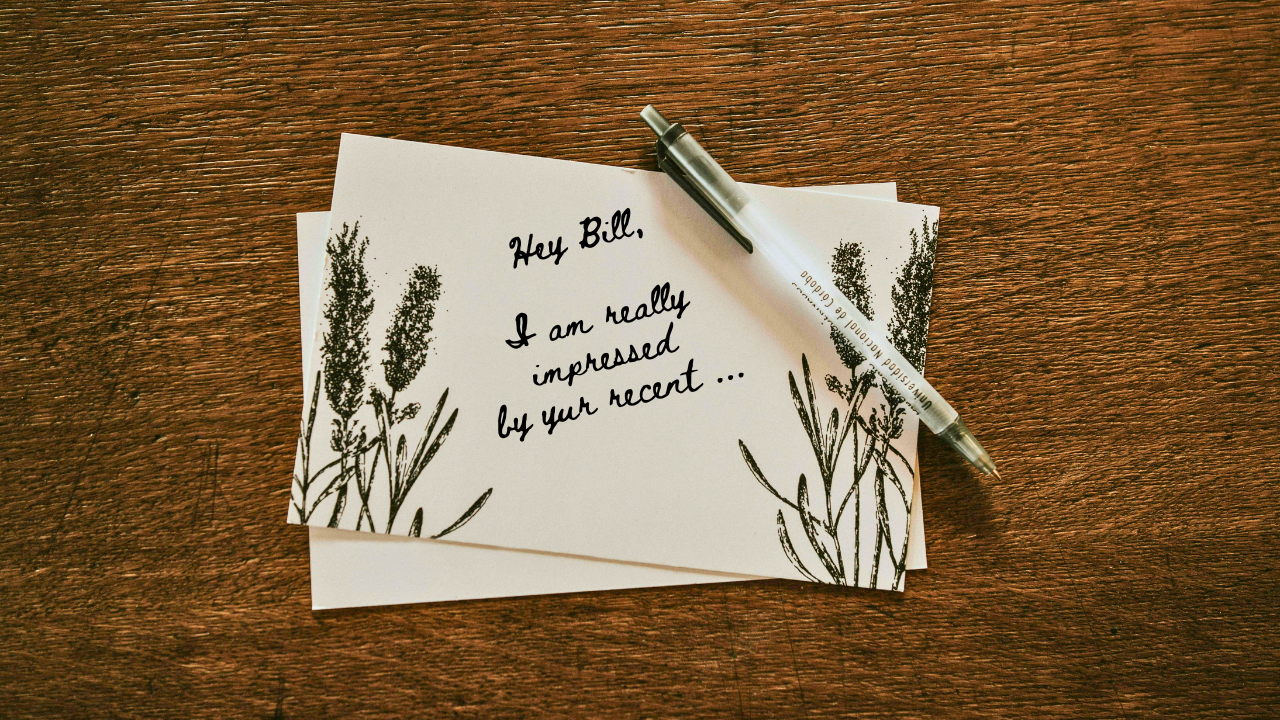
Like all of the best things in life, it arrived unexpectedly. It was a small note with just my name at the top; clearly handwritten.
The note was from someone who chaired a committee that I was part of, someone I had long looked up to. She was a tour de force of a leader, and I have often used her as a benchmark for reading the room and leading a team.
And there she was, writing to me.
She thanked me for my contributions, and then she shared something her father had told her. I have never forgotten it.
“My father once told me that there are two types of people: those who do the work, and those who take the credit. He told me to try to be in the first group. There was much less competition.”
I was grateful not simply for the words, but for the effort behind them. She had sat down, picked up a pen, and chosen to make me feel seen.
Every time I showed up to that committee after receiving her note, I showed up with more energy, giving more of myself—every time.
That small act had such a big reach. It had me thinking about what we’re leaving on the table in our workplaces.
Effort Signals Value
There is an important lesson in a handwritten note. It costs something.
Not money. It costs time. And that signals intention. It’s the conscious decision to stop, reflect on someone, find a pen and paper, and put thoughts into words.
In my policing career, I will always remember the day the Superintendent called me into his office because he’d received a handwritten letter on courthouse stationery from a judge that I had given evidence in front of earlier that day.
The moment I walked in, my boss waved the letter at me and said he had never, in his career, received a handwritten letter from a judge before. My amygdala kicked in as I braced for whatever came next. But instead of a reprimand, the judge had written to share a compliment.
Again, something I will never forget.
A text takes five seconds. An email takes two minutes. A handwritten note is on an entirely different level. The person receiving it feels that difference, even if they can’t always name it.
The Digital Noise
In a world saturated with digital noise, the physical act of writing something down by hand sends an unmistakable signal: you were worth my time. That’s a message no emoji can replicate.
For supervisors, this matters enormously. The people on your team are always watching, trying to work out whether they matter to you, not just as resources or headcount, but as people.
A handwritten note achieves something a performance review never can. It says: I see you.
Specificity Is the Secret
Back to my note and the judge’s letter.
The significance of handwriting aside, the correspondence’s importance lay in its content.
The committee chair didn’t write “Great job!” or “Thanks for everything.” She shared something personal, her father’s wisdom, and connected it directly to what she had observed in me.
That level of specificity tells the recipient, “I actually paid attention.” I thought about you, specifically. The judge’s letter did the same. It described in detail how I had delivered my evidence in court and what he had appreciated about it.
Generic praise is easy to dismiss. “You did a great job on that project” rolls right off. “The way you stayed calm when the timeline shifted, and kept the whole team focused, that made a real difference” sticks. It sticks because it’s true, and because it proves you were watching.
The most powerful appreciation is always specific. It names a behavior, a moment, a quality, and connects the dots to why it mattered. When a supervisor does that, it tells the person: keep doing that. This is who you are at your best.
The Ripple Effect of One Genuine Act
The note and the letter didn’t just make me feel appreciated in the moment. They changed how I showed up afterward.
One person’s intentional act of appreciation didn’t just affect me. It rippled outward to everyone I worked with. Supervisors sometimes underestimate this: appreciation isn’t just a nice thing to do. It’s a performance strategy.
Research consistently shows that employees who feel genuinely recognized are more engaged, more productive, and more likely to go above and beyond, not because they have to, but because they want to.
Mike Robbins TED Talk
There’s a great TEDx talk we show in some of our leadership workshops: The Power of Appreciation, by Mike Robbins.
Well worth a look.
Appreciation compounds. When one person on a team feels seen and valued, they show up differently, and that affects team morale, which affects output, which affects results. The return on a five-minute investment in a handwritten note is incalculable.
Bringing It Together
Don’t wait for a special occasion. You don’t need a milestone or a performance cycle. You need a few minutes, something worth saying, and the willingness to say it in a way that costs you something, because that cost is exactly what makes it mean something.
Pause for a moment
Think about someone on your team who does the work quietly, consistently, without waiting for applause. I wrote about people like this in a recent Workplace YOU 2.0 newsletter, calling them Load Bearers. It’s the person who shows up, follows through, and makes everyone around them better. The person the chairwoman’s father would have pointed to.
Do they know that you’ve noticed?
Here’s what I’ve learned. The people who do the work often assume they’re invisible. They’re too busy doing the work to advocate for themselves. They don’t seek the spotlight, and they don’t need it. They show up.
A handwritten note says, “I see you.” I was watching. And what you do matters. That’s not just good leadership. It’s the sort of thing people remember for the rest of their careers. I know, because it happened to me!
Now I’m asking you to follow suit.
A quick reflection: When did you last take five minutes to write something down for someone on your team? Not in a review. Not in an email. In a way that cost you something.