Leadership Lessons I Didn’t Expect in a Tulip Field
I have stood before many audiences in my life. Last week, I found myself standing in a tulip field at the Abbotsford Tulip Festival with my grandchildren. I had to pause and take a breath; the moment surprised me, and the leadership lessons are worth remembering.
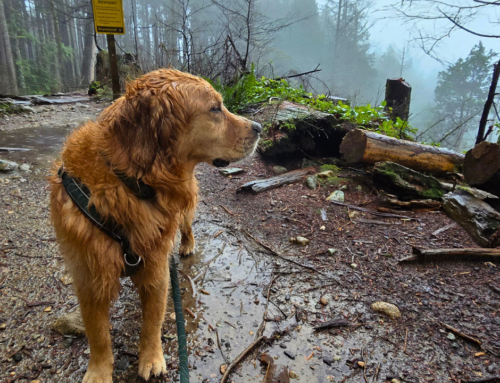
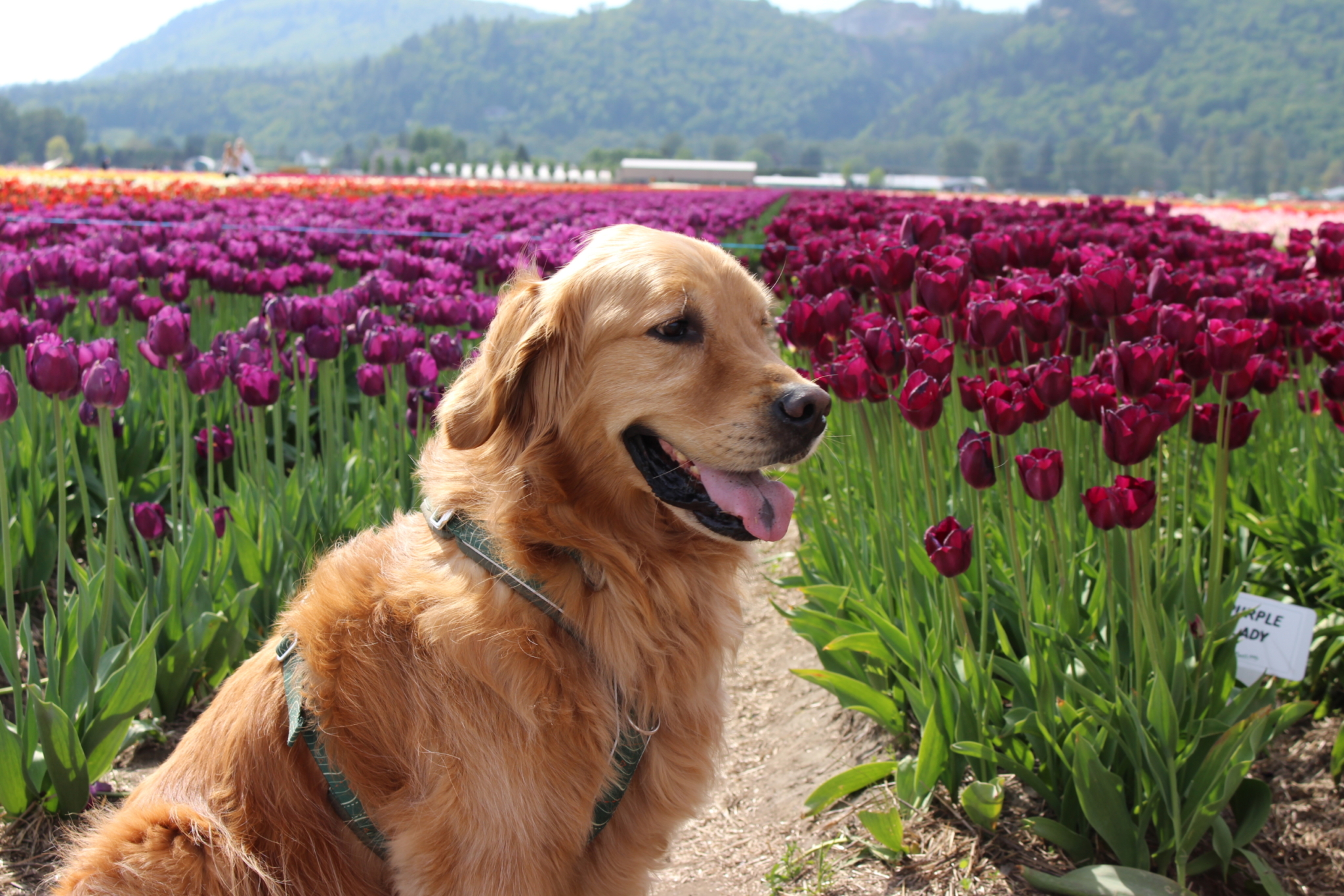
I went to spend a morning with our grandchildren and see the world through their eyes. I enjoy witnessing their happiness and having their little hands tug me toward the next thing, catching their short attention span. (It was pet-friendly, so Henry, our CEO, was there as well.)
I had never been to a tulip festival before this year, so I wasn’t sure what to expect. But what I found grabbed my attention and has stayed with me.
Piano’s in the tulips?
There were rows and rows of red, yellow, purple, white, and pink tulips, many of which I couldn’t even name, stretching all the way to the edge of the Fraser Valley sky. More than a hundred varieties, planted from over a million bulbs. No photo could capture how stunning it was. Henry and I tried, but failed miserably.
But then, scattered unexpectedly through the fields, there were working grand pianos. They were set up so anyone who could play was welcome to sit down and perform. As we wandered among the colorful rows, piano music floated across the flowers.
There were also huge yellow wooden clogs, big enough for a whole family to sit inside and laugh while someone took a picture. We even have photos to prove it.
There were children running. There were strangers smiling at strangers. Drones flying. And lots of professional photographers with their clients, taking pictures with a brilliant backdrop.
I had questions
How does all of this come together? Who decided where each bulb should go? Who gets up at five in the morning to check for frost? Who looked at a tulip field and thought, “You know what this needs? A grand piano, or eight of them…?”
I knew that what looked effortless was nothing of the sort.
What seemed like nature putting on a show was really just the visible result of a huge amount of unseen work.
The longer I stood there, the more I realized I was seeing several leadership lessons, displayed in living color.
What the growers do is what the best leaders do.
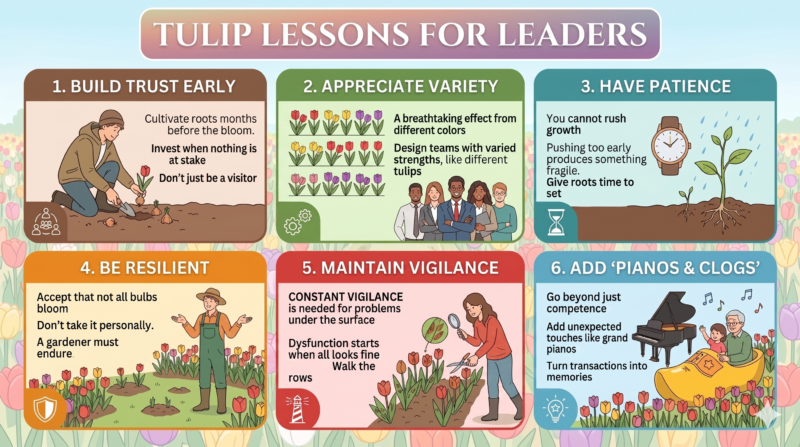
Long before any of us arrived with our cameras and grandchildren (and golden retriever CEOs), those growers were out there working away in cold soil.Months before, in the dark days of autumn, they were testing pH levels, checking drainage, and planting bulbs one by one. Remember, there were over a million bulbs!
They were doing the low-key work that nobody photographs or applauds. But it is the work that made everything I saw possible.
The bloom is paid for in the planting season.
This is the one leaders tell me they understand – but do they?
We’ve been called in many times to help a team that’s already broken — zero trust, in disarray. It’s important work. But the team that stayed strong under pressure in March was actually built back in October. Trust was forming through relationships, one conversation here and a “good job today,” there.
If you only show up for your team when it really matters, you’re just a visitor in your own organization.
The growers I watched were not visitors. They were there in the cold, and they were there now, in the sun, and they will be there when the field is bare again.
Variety
Nobody drives to the Abbotsford Tulip Festival to see a single color.
The stunning effect comes from carefully arranging different colors, row after row. The tulip grower doesn’t apologize for this. In fact, it’s all by design.
The best leaders do the same thing. They never want a team of people just like themselves. Their teams consist of people with different strengths, and they make sure those strengths are put to good use.
Patience
You can’t rush a tulip.
Even if you do everything right, you still have to wait. I have learned this the hard way more times than I would like to admit, both as a police officer and as a consultant, trainer, and coach.
Pushing people into readiness before their roots have set produces something fragile every single time.
You see this in workplaces when new supervisors and managers are put into roles with little more than hope from the organization. They may have been great subject matter experts, but they have never been responsible for helping someone else grow.
You can’t rush people.
The lessons that took me longer to see
There is a layer to all of this I didn’t see coming.
After talking to some of the professionals tending the fields, I learned that the growers know that a percentage of bulbs will not come up. They plant for it, and they don’t take it personally.
- I didn’t know, in my early years of leading teams, that not every bulb would succeed. I took the outcome personally. But we learn, don’t we, that it is the nature of our work to tend to the garden, and let the bulbs do their work too. Otherwise, we are sure to burn out in the process.
- These growers also walk the rows, but not for the visitors. They are walking and looking specifically for trouble. They are looking for thirsty leaves, that off-color flower, or an early signature of disease.
- That’s why constant vigilance is needed. I was told that Botrytis tulipae is a fungus that can attach itself to almost anything under the right circumstances. It causes dark patches on tulip flowers and thrives in moist, humid environments. When tulip leftovers remain in the soil, the fungus survives. Even when new tulips are planted in that same soil, the pathogen can persist, infecting the new plants and causing leaf and flower spots.
Problems can hide beneath a healthy-looking field and go unnoticed if you only take a quick look.
I sat with that one for a while, because I immediately connected it to workplaces and teams.
In my experience, dysfunction in a team almost always enters during the season when everything looks fine.
The leader who only walks the rows when something is obviously wrong is already too late.
And then there is deadheading
Or more kindly phrased – deliberately removing the spent bloom so the plant does not waste energy on seed production.
By doing this, the grower cuts off the very thing they worked for. But if they don’t, next year’s plants will be weaker. That’s a sure thing. The team leadership equivalent will never feel good, but it provides a healthier future.

Bulb is the assest and the bloom is the marketing
The deepest lesson (pun intended) came when I was told that the bulb is the asset and the bloom is the marketing.
A properly cared-for bulb multiplies underground. One bulb becomes three, three become nine. The flower is beautiful, but the real work happens underground, out of sight.
When I look at my own company, twenty-five years in, the workshops, the coaching, the keynotes, the proposals: these are the blooms. The bulbs are the relationships, the standards, and the quiet investments in people.
I was told that if a grower loses those bulbs, they will have one good season left. Two at best.
That should make leaders ask themselves if they’re truly paying attention, or just glancing now and then.
The pianos and the clogs
And then there were the pianos and the giant yellow clogs.
I keep returning to these because the growers did not have to do any of that.
The tulips alone would have been more than enough. Most operations would have stopped at the product and called it a day.
But someone decided this should be more than just a field of flowers. Someone thought a child should be able to sit inside a wooden clog as big as a small boat. Someone wanted a grandparent to hear live piano music drifting across the colorful fields on a Thursday afternoon.
That, for me, was the lesson I did not see coming.
The leadership lesson that took me by suprise
The best leaders I have ever known do not stop at simply being competent. They do not stop at the deliverable. They put a piano, or eight pianos, into the field.
The unexpected gesture, that personal element, is a small bit of magic that turns a transaction into a memory.
My grandchildren won’t remember the names of the tulip varieties — honestly, I can’t remember them either. They’re too young, and that’s not what sticks with children anyway.
But I think they will remember the music.
I think they will remember climbing into a yellow clog the size of a rowing boat.
I hope they’ll remember the day grandpa grew quiet in a field of color, held their hands, and simply felt happy for a while.
That is what great leadership feels like, too.
From the inside, and from the outside.
It is worth every cold morning in the soil.
Did I mention that if you’re able to, you should visit the Abbotsford Tulip Festival?